

Structural Health Monitoring of Mine Shafts
The Project Site
GEO-Instruments Canada provided instrumentation and monitoring during development of a potash mine in Saskatchewan. The potash deposits were 900 meters underground, so the mine had to construct access shafts.
Instrumentation was required during construction of the shafts and also for large-scale testing of the concrete mixes that would be used in the final shaft liners.
The shaft liners were built from the bottom upwards. They consisted of an outer continuous-welded steel liner and poured concrete, which was 1 to 2 meter thick and specially formulated for this project.
GEO-Instruments was also asked to implement long-term structural health monitoring for the shafts.
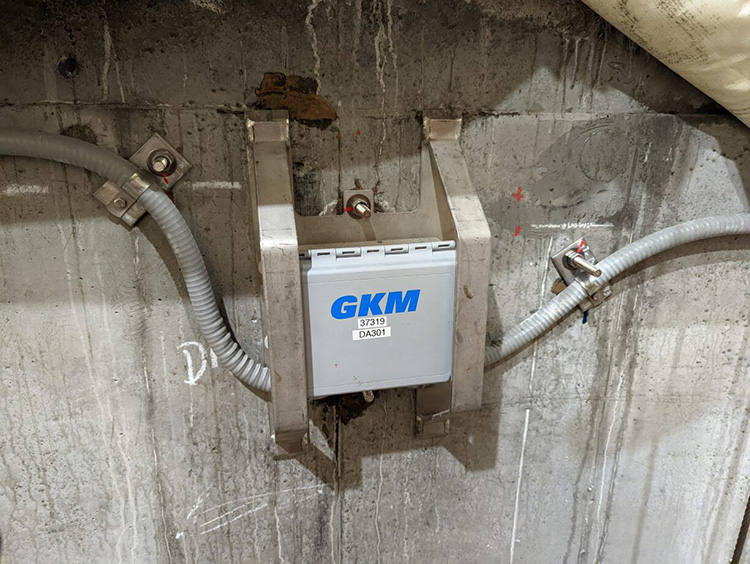
Loggers were protected by enclosures and welded steel frames, and cables to sensors were routed through conduit, as shown in the photo above.
Health Monitoring Requirements
The shafts had a design life of 100+ years. Risk factors included aging, water ingress, and the use of new construction methods and concrete recipes.
Parameters to be monitored included strain and temperature in the concrete, strain in the steel outer liner, and displacements across joints.
Sensor longevity was an important consideration, since structural health monitoring is meant to continue for years. Daily measurements or better were preferred for analysis.
The final liner was constructed from the bottom upwards. The installation crew had to work from a galloway, which is a multilevel platform suspended from the top of the shaft.
Implementation
GEO-Instruments chose to deploy vibrating wire sensors, which have low power requirements and are known to survive harsh conditions.
78 embedment strain gauges and 22 temperature sensors were installed in the concrete. 22 weldable strain gauges were installed on the steel outer liner, and 24 displacements sensors were installed at joints.
Sensors readings were automated with wireless, battery operated dataloggers, which transmit hourly readings to gateways located in the headframes at the top of the shafts.
The gateways forward the readings to the mine's data management systems, which provide data visualization. Alerts are triggered if a reading exceeds a limit value or a rate of change defined for each sensor.
Advantages
- Automation contributes to the safety of workers who would otherwise need physical access to the sensors to take readings.
- Wireless loggers can start delivering measurements as soon as they are installed, with no need to wait for implementation of the entire system. This early access to data informed any design adjustments and construction decisions.
- Wireless data loggers also eliminated the cost of installing and protecting cables.
- Very little maintenance was required because the energy efficient loggers and vibrating wire sensors can operate on batteries for years.
“The health monitoring system has proven to be highly reliable since the start of the project in 2019. Trust in the structural health monitoring system lets the mine owner focus on the next steps of the mine construction.” - Vincent Le Borgne, Mining R&D Manager, GEO-Instruments Canada (formerly GKM Consultants)